
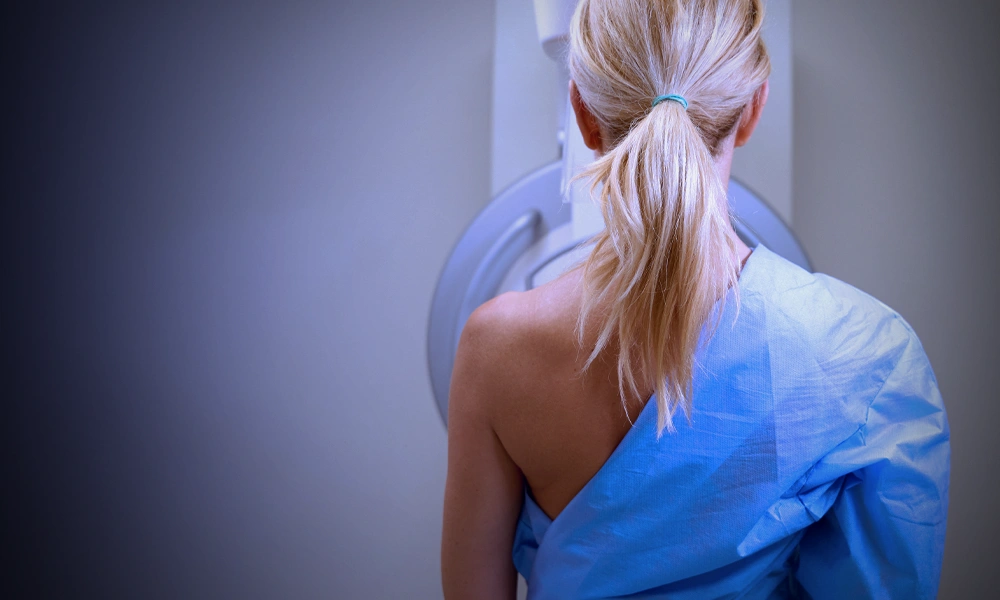
What is mammography?
Mammography is a type of low-dose X-ray of the breast. It reveals masses and micro-calcifications within and around the breast that may indicate breast problems including, but not just limited to, cancer.
We use digital mammography at all of our sites, which delivers substantial advantages to you and to your provider:
- Higher quality images than traditional film.
- Reduces the number of retakes and repeat procedures.
- Less time spent in the exam room, approximately 15–20 minutes for the entire exam.
- Faster communication of results to your referring provider.
- Easy, secure sharing with some of the most qualified women’s imaging specialists in the country.
- Enhanced Breast Cancer Detection (EBCD), an optional add-on at participating centers that applies DeepHealth’s FDA-cleared AI to 3D screening mammograms, helping radiologists find cancers across all breast densities.
- Greater accuracy than film for women with dense breasts.
When is it used?
Experts recommend a mammography screening of the breasts at regular intervals to increase the chance of early cancer detection and treatment.
The American College of Radiology recommends women aged 40 and older should have a screening mammogram every year and should continue to do so for as long as they are in good health.
-
01
Bilateral screening mammography
Standardized imaging for both breasts to detect subtle asymmetries.
-
02
3D mammography (digital breast tomosynthesis)
Layer-by-layer slice imaging that unmasks tissue hidden in dense breasts.
-
03
Specialized AI oversight
Automated routing of high-suspicion cases for additional review by a breast imaging subspecialist.

Inside the exam
You stand at the machine
In the exam room, the technologist will position you standing at the mammography machine and place your breast over the receptor.
A few seconds of compression
The machine applies moderate compression to your breast for a few seconds to obtain the clearest image. You will be able to communicate with the technologist during the procedure.
Usually two views of each breast
Two X-ray views are usually taken of each breast with a digital mammogram.
A quality check, and you go
The technologist will view your images on the computer screen in the room, only to assess the image quality. You can leave immediately and resume normal activities.
Exam preparation
We want your exam to be as comfortable and hassle-free as possible, so we provide all the information you will need to prepare before you arrive.
Your specific exam has its own instructions. You will find them on the Exam Preparation page.
All exam preparationOn the day of your appointment
-
Please do not wear any perfume, powder, deodorant or lotion around the breast area.
What to bring
-
Your physician’s order for a diagnostic mammogram. Screening mammograms do not need one, but we do need your provider’s details on file.
-
A list of the medications you take, including non-prescription medications and supplements.
-
Insurance cards.
-
Prior to your appointment, we ask that you please obtain any images and reports for any breast imaging you’ve had in the past at another facility.
Common questions
Experts recommend a mammography screening of the breasts at regular intervals to increase the chance of early cancer detection and treatment. The American College of Radiology recommends women aged 40 and older should have a screening mammogram every year and should continue to do so for as long as they are in good health.
Digital mammography means less time spent in the exam room, approximately 15–20 minutes for the entire exam.
The machine applies moderate compression to your breast for a few seconds to obtain the clearest image. You will be able to communicate with the technologist during the procedure.
Please avoid using deodorants, powders or lotions under the arms or on the breasts on the day of your exam. These substances can appear as calcium spots on the image, and avoiding them helps give the radiologist the clearest possible view of your health. Most deodorants and antiperspirants contain aluminum, and aluminum particles look like tiny white dots that mimic calcifications. If you are worried about odor, bring your deodorant with you and apply it after the exam.
Mammography is a type of low-dose X-ray of the breast. Its radiation dose is tested each year against federal limits, so the risk is very low.
In the United States, approximately 70% of screening mammograms are interpreted by general radiologists rather than breast imaging specialists. RadNet uses DeepHealth’s Breast Suite to bridge that expertise gap, and its Safeguard Review routes high-suspicion cases for additional review by a contracted breast imaging subspecialist before a final recall decision is made. The decision itself is always made by a radiologist.
Yes. Please provide access to any mammograms performed at other facilities for vital year-over-year comparison. Without them your results may be delayed, or you may be asked to return for additional imaging. If we are able to obtain them on your behalf, we will. If we are unable to, you may be asked to retrieve them.
Density is common and it is not a diagnosis. Discuss what it means for your own screening with your physician.
How often a screening mammogram is covered depends on your plan. Traditional Medicare pays once 11 full months have passed after the month of your last screening mammogram. Check with your plan before you book.

Find a mammography location near you
Not every center offers every breast imaging exam. Confirm the exam you need when you book.