
Screening Mammography at Chesapeake Medical Imaging

What is a Screening Mammogram?
Mammography is a type of low-dose X-ray of the breasts. It reveals masses and micro-calcifications within and around the breast that may indicate breast problems, including but not just limited to cancer.
Experts recommend a screening mammogram annually to increase the chance of early breast cancer detection and treatment. Women who qualify for annual screening mammograms should continue to undergo screening mammography as long as they are in good health.
Chesapeake Medical Imaging offers Screening Mammograms at multiple locations on the Eastern Shore, making it easier for you to access this important screening exam. Schedule your next annual Screening Mammogram at Chesapeake Medical Imaging.
Who is a Candidate For a Screening Mammogram?
- Women 40 years of age or older
- Women at high-risk for breast cancer can begin at age 30
Prior to your annual screening mammogram, you will be asked a series of questions to determine your risk for breast cancer. Learn more about risk assessment here.
High-Risk Patients:
- You or an immediate family member have the gene mutation, BRCA1 or BRCA2
- Received radiation therapy to the chest/thorax when they were between the ages of 10 and 30
Prior To Your Exam
If you did not get your last mammogram with us, please obtain your previous mammogram images and reports. Please either bring them with you to your appointment or have them sent to our office. *This is not required if you came to our facility previously.
How to Prepare For a Screening Mammogram?
DO NOT use any powders, talc, sprays or deodorants on your breast or in your underarm area before your exam.
How is a Screening Mammogram Procedure Performed?
- A technologist will position you standing at the mammography machine and place your breast over the receptor.
- The machine applies moderate compression to your breast for a few seconds to obtain the clearest image.
- The 3D Mammography machine moves in an arc over the breast, taking many X-rays from different angles. The X-ray can generally take 11 images in 7 seconds. A computer then processes the images to form a clear 3D image. The whole procedure may take around 30 minutes.
- When you SAY YES to Enhanced Breast Cancer Detection (EBCD), no additional radiation or time during your visit is required. You safely gain the benefit of state-of-the-art screening with the incorporation of artificial intelligence on your exam.
- During your exam, you will be able to communicate with the technologist who will be assessing the quality of the images for the interpreting radiologist.
What to Expect After a Screening Mammogram?
- You can leave immediately and resume normal activities.
- Your exam will be read by a board-certified, sub-specialized radiologist who has undergone additional training in women’s imaging interpretation.
- Results will then be sent to your ordering health care provider.
- If the radiologist requires additional imaging to interpret your study, then you will receive a call to come back for a diagnostic mammography exam.
Did you know your mammogram can give insight into your heart health?
When reviewing your mammogram, radiologists can look at more than just your breast health. They can also evaluate and report key findings that may be associated with heart health. Advanced Radiology is now using enhanced technology for reporting on breast arterial calcifications — calcium deposits in your breast arteries that may signal increased risk of heart attacks, stroke and heart disease.
FAQs About Breast Arterial Calcification (BAC)
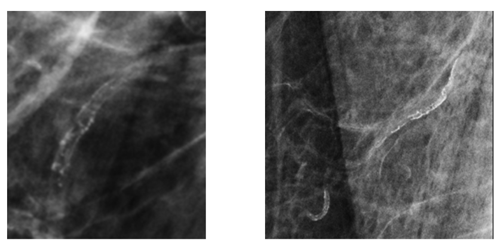
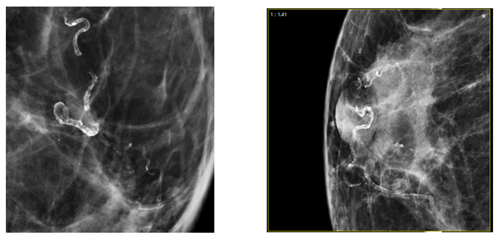
If a Breast Arterial Calcification is noted in your report or results (lay) letter, it means that when the Radiologist reviewed and read your mammogram, they noted there are calcium deposits present in the walls of the arteries within your breast. While a Breast Arterial Calcification itself does not cause heart disease, its presence and other traditional risk factors may serve as an early warning sign of increased risk of cardiovascular disease.
If the Radiologist has noted Breast Arterial Calcifications are present on your mammogram, please note this is not an indication of Breast Cancer.
We believe in providing you with comprehensive information about your overall health. If our radiologist noted a Breast Arterial Calcification within your results, you should discuss this finding with your healthcare provider to assess your individual risk for developing cardiovascular disease.
Breast Arterial Calcifications follow the path of the vessel and the calcifications are located within the vessel. These calcifications are not an indication of Breast Cancer. If you have questions, consult your healthcare provider for additional information.
No, the presence of Breast Arterial Calcifications does not mean you have breast cancer, nor are you at a higher risk for breast cancer.
Breast Arterial Calcifications are related to cardiovascular health rather than breast cancer. For this reason, the breast radiologist's role is to report their presence. Your healthcare provider or cardiologist is best equipped to evaluate your overall cardiovascular risk factors (such as blood pressure, cholesterol, family history, and lifestyle) to determine what, if any, specific follow-up testing is appropriate.
While they can occasionally be seen on other modalities, mammography is the most sensitive and primary imaging tool that easily visualizes specific Breast Arterial Calcification deposits.
Yes. Breast Arterial Calcifications become more common as women age. They are seen in approximately 9% to 17% of mammograms for women under the age of 50, but can be present in up to 50% of mammograms for women over the age of 65.
The American Heart Association notes that multiple studies suggest a strong association between Breast Arterial Calcifications and cardiovascular disease. RadNet believes that providing this screening information empowers you to be as informed as possible about your personal health.
If Breast Arterial Calcifications are seen by our Radiologist, we will notify your breast health provider, along with any other providers you asked us to share your breast health report with at the time of your service. We encourage you to have a conversation with your provider about these findings and if any additional testing or follow-up is needed.
There is no need for immediate concern. We share this information so you can be proactive regarding your potential risk of cardiovascular disease and discuss it with your healthcare provider. Breast Arterial Calcifications are not an indication of breast cancer nor breast disease.
You and your provider will review your personal overall risk factors and decide what is the best pathway for you and your overall screening health.
No, they will not. Once calcium deposits form in the arterial walls, they remain and will continue to be visible on your annual mammograms year after year.
As you age, Breast Arterial Calcifications may increase and become more prevalent on your mammogram.