

Enhanced Prostate MRI Screening
AT DELAWARE IMAGING NETWORK
Advanced MRI screening for the early detection of Prostate Cancer in men aged 45 and older
Schedule an Appointment Today at Delaware Imaging Network

1 in 8 Men
will be diagnosed with prostate cancer during their lifetime, similar to a woman's lifetime risk of breast cancer.1
Early detection saves lives.
Routine screenings help detect prostate cancer in its earliest stages, when treatment is often most effective.
What is Enhanced Prostate Screening?
Enhanced Prostate Screening (EPS) is a supplemental Prostate MRI screening that provides a fast, accurate, and non-invasive way to detect prostate cancer early.
EPS combines Artificial Intelligence (AI) technology with a rigorous clinical review process to significantly enhance the accuracy of Prostate MRI screening. AI assists radiologists by identifying subtle lesions during image review, helping support earlier detection.
Who is Eligible?
- Men aged 45 and older
- While a PSA (Prostate-Specific Antigen) score is not required, it is recommended. If available, your PSA must be less than 10 and obtained within the last year. For an explanation of PSA, click here.
- This screening is not appropriate for men who have previously been diagnosed with prostate cancer or have had a prostate biopsy.

No Referral Required
You do not need a physician's referral for this potentially life-saving screening.

More Sensitive Than PSA Alone
MRI can detect cancers that may be missed by PSA blood testing alone.2

Non-Invasive
No injections or digital rectal exam. The screening is quick, comfortable, and non-invasive.

No Radiation
MRI uses magnetic fields instead of radiation, making it a safe screening option.
What Can You Expect From Your MRI Screening?
Simple Self-Pay Option
Insurance does not currently cover this screening.
The self-pay fee is $275.
Minimal Preparation
You'll receive easy-to-follow prep instructions before your appointment.
Comfortable for Claustrophobic Patients
The exam is quick and performed feet first, so most patients keep their head outside the MRI scanner.
AI-Assisted Review
Artificial Intelligence assists our experienced radiologists in identifying subtle findings for greater diagnostic confidence.
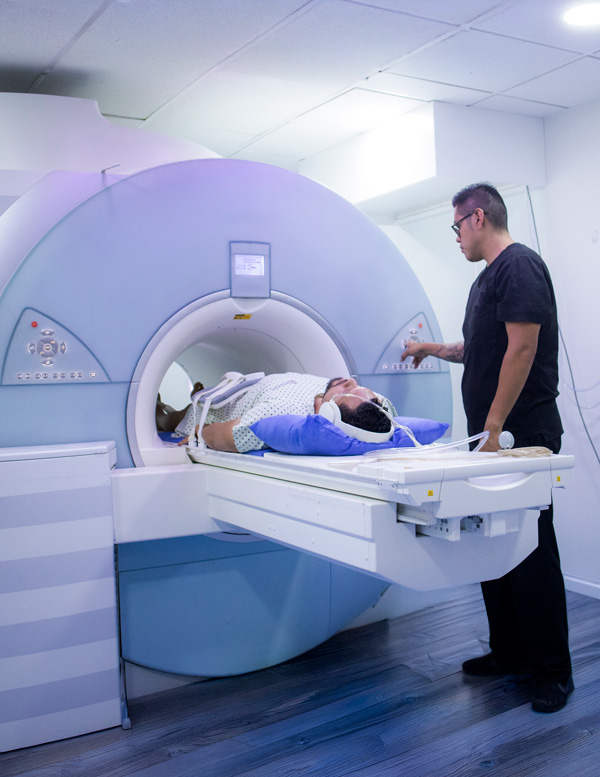
A quick MRI exam enhanced with Artificial Intelligence helps detect prostate cancer earlier—without radiation or invasive procedures.
Enhanced Prostate Screening at
Delaware Imaging Network
Why Choose Delaware Imaging Network?
- Compassionate, professional care from skilled technologists who prioritize your comfort.
- Board-certified, sub-specialized radiologists.
- Advanced equipment and technology, including AI.
- Accurate and timely results.
- High-quality, cost-effective imaging.
FAQs – Frequently Asked Questions About
Enhanced Prostate Screening
Do I need an MRI screening if I’m healthy and don’t have a family history of prostate cancer?
Prostate cancer can form in healthy individuals without a family history of the disease. As you age, your body changes. A baseline prostate MRI and routine screenings help you and your provider understand your health and whether changes are normal or abnormal. This is an important discussion for you and your provider to have.
What is Prostate-Specific Antigen (PSA)?
Prostate-specific antigen (PSA) is a protein produced by the prostate gland. A PSA test measures the concentration of this protein in the blood. It is primarily used as a screening tool for prostate cancer and to monitor the disease in patients who have already been diagnosed.
Are MRIs painful?
MRI scans are painless and safe. Our procedure does not use contrast (a fluid injected into your body to create certain images) or a probe injected into the rectum. Our exam is fast and does not require any invasive measures. Artificial intelligence, a key component of Enhanced Prostate MRI, does not add time or discomfort to the procedure.
I’m nervous about getting a scan. What if they find something?
A delayed cancer diagnosis is harder to treat than if found early. Information is power. Early detection offers men a five-year survival rate of almost 100%.
Does MRI use radiation?
No, MRI scans do not use radiation.
Am I too young for a prostate MRI?
We advise a baseline scan at the age of 45. Your trusted provider understands your medical history and risk, and that physician can help determine the optimal way to plan your prostate screening. If you have been diagnosed with prostate cancer in the past, screening is not appropriate for you.
Is my screening prostate MRI exam covered by my insurance?
Currently, insurance carriers do not cover the Enhanced Prostate MRI exam. There is an out-of-pocket cost of $275 for the screening.
What is the difference between a screening and a diagnostic MRI?
Screening prostate MRI exams are meant for men who have NOT been diagnosed with prostate cancer and do not have any of the typical symptoms of prostate cancer. A screening prostate exam helps identify potential disease at an early stage, so that it will be easier to treat.
Diagnostic prostate MRI exams are follow-up exams after a patient has visited the doctor with complaints or abnormal lab results. Generally, a blood test called Prostate-Specific Antigen (PSA) is ordered first. If the results are above a certain threshold or rising, and a manual exam of the prostate returns suspicious results, you can be referred for a diagnostic prostate MRI. Diagnostic exams are typically covered by insurance, whereas screening exams are not.
Is it necessary to do prostate MRIs often?
Screening results and family history will indicate the interval at which you should return for routine screening. If your MRI exam shows no signs of prostate cancer, it is still possible for you to develop cancer in the future. It is unlikely for this to happen within a short period of time, but your physician can guide you on the interval, usually between one and five years, that is right for you.
Should I get a prostate MRI screening?
After age 40, your chance of getting prostate cancer significantly increases as you age. Additional factors that increase your risk for prostate cancer include having family members with the disease, having genetic risk, or being African-American. In these cases, screening with a prostate MRI can help detect the development of prostate cancer, especially since the standard blood test for prostate cancer (PSA test) can miss cancers. If you have been diagnosed with prostate cancer in the past, screening is not appropriate for you.
I have elevated PSA levels. Should I get an MRI first, or go directly for a biopsy?
Consult with your provider about the appropriate clinical steps to take. A PSA blood test is not always accurate at detecting prostate cancer. Your physician can advise whether an invasive biopsy is the next step. Enhanced Prostate MRI leverages artificial intelligence and advanced technology to deliver enhanced detection of prostate cancer.
How should I prepare for my scan?
Patients will receive complete prep instructions before the exam, which vary based on health history. For those with chronic constipation, an at-home enema is recommended before the exam. Patients who opt not to prepare with an enema are informed that the image quality may be affected as a result. There is a 10-15% incidence of limited diagnostic quality in the posterior area, where prostate cancer is most common. This will be noted in the exam report. Begin a clear liquid diet starting 8 hours prior to your appointment. Clear liquids include water, soup broth, Jello, hot/cold tea, Gatorade, and water-based popsicles. Take 2 Gas-X 125mg soft gels 25 minutes prior to your scheduled appointment. Do not wear any kind of metal, such as hairpins or jewelry.
If you have claustrophobia, rest assured that your head remains outside of the MRI unit.
Patients with a continuous Glucose Monitoring System or Neulasta device will remove the device before the exam, and therefore should bring a replacement sensor to wear following the scan. The exam cannot be performed with that device in place, regardless of body part being imaged.
Patients with a cardiac monitor; Medtronic drug infusion system; nerve stimulator; or programmable shunt, stent, eye, or ear implant must contact us with the device name and model before the appointment. This ensures patient safety. Likewise, those with a pacemaker or heart defibrillator must contact the office before the exam.
What should I expect during the MRI scan?
Our trained technologists will help you lie down on the MRI bed that will slide into the scanner. If you are claustrophobic, be assured that your head will not be inside the unit; you enter feet first. You do not need to undress for the MRI, but do wear comfortable clothes with no metal (such as zippers). You will remain still on the scanner for a short period of time to capture the images. Your physician will contact you to discuss the results.
I have claustrophobia. Can I get an MRI scan?
Yes. For the prostate MRI, your body enters the scanner feet first, which allows your head to be outside of the unit. We work with a shortened MRI protocol, so the exam is as quick as possible.
How is the Artificial Intelligence (AI) used by radiologists and how quickly can it process images?
EPS leverages DeepHealth's FDA-cleared, AI-powered prostate solution to assist radiologists while they are interpreting your MRI exam. It processes the images and very quickly displays clinical information for the radiologist to use.
Does this replace the radiologist? Is a computer going to be processing my MRI scan?
No. This technology does not replace the radiologist. EPS leverages DeepHealth's FDA-cleared, AI-powered prostate solution to assist the radiologist by providing additional information, which is factored into the interpretation of your exam.
Has the AI been reviewed by the FDA?
Yes, DeepHealth received FDA clearance.
What if the AI finds something suspicious, then what?
When the radiologist is reading your exam, AI technology shows areas of suspicion for further attention. The radiologist uses their training and expertise to arrive at the final interpretation of the exam, including whether follow-up imaging or tests are needed. If your exam has a suspicious finding, a physician will discuss this with you and will review the different options for follow-up care.
Are the MRI images and my personal information shared and stored in a secure way?
Yes. All your personal information, including the MRI images, is stored in a secure patient portal, only accessible by you and your healthcare providers.
Do I get a report from the exam?
Patients will receive a lay letter with their results. If a provider’s name wasn’t provided at the time of scheduling, they will receive a copy of their report as well. This report indicates the findings of your exam and whether you have abnormalities in your prostate. It is important that you discuss the report with your physician.
www.radnet.com/delaware-imaging-network/for-patients/patient-portal
Schedule an Appointment Today at Delaware Imaging Network
Watch Our Videos to Learn More About the Importance of Enhanced Prostate Screening

Enhanced Prostate Screening Saved My Life
Dr. Bernard Schayes shares his personal experience and explains why early screening made all the difference.
The Hardest Part: Make Prostate Screening a Priority
Learn why taking the first step toward screening could help protect your long-term health.

A Father's Story: Why Prostate Screening Matters
Hear how prostate screening can impact families and why early detection is so important.
Sources
- American Cancer Society
- https://jamanetwork.com/journals/jamaoncology/article-abstract/2817308
https://www.ncbi.nlm.nih.gov/pmc/articles/PMC9184263/