
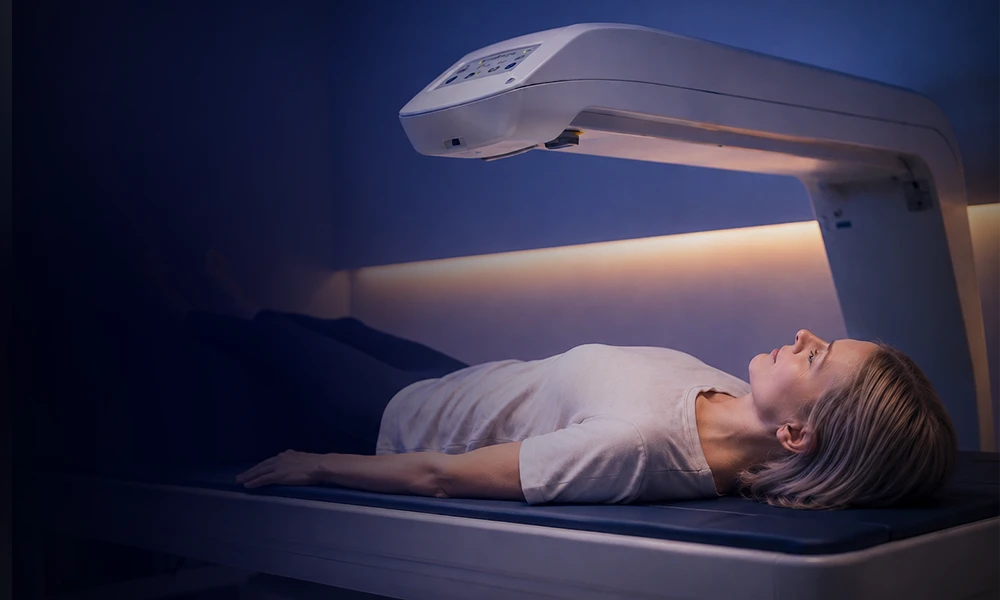
What is a DEXA scan?
DEXA (Dual-Energy X-ray Absorptiometry) is a quick, painless, low-dose imaging exam that provides valuable insights into your bone health and body composition, helping you take a more proactive approach to healthy aging.
A DEXA scan is an advanced imaging exam that uses two low-energy X-ray beams to measure bone mineral density or evaluate body composition.
DEXA is considered the gold standard for measuring bone mineral density and is commonly used to diagnose osteoporosis, assess fracture risk, and monitor changes in bone health over time.

DEXA for healthy aging
Healthy aging is about more than adding years to your life. It’s about staying strong, active, and independent throughout those years.
As we age, our bodies naturally change. Bones may become less dense, muscle mass can decrease, and body fat distribution may shift. Many of these changes happen gradually, often without noticeable symptoms.
From detecting early signs of osteoporosis to evaluating bone quality, identifying hidden spinal fractures, and measuring body fat and lean tissue mass, DEXA offers important information about what’s happening inside your body.
Why DEXA matters for healthy aging
Maintaining strong bones and healthy muscle mass plays an important role in mobility, balance, and independence as we age.
Whether you’re focused on preventing osteoporosis, maintaining strength, managing your weight, or simply understanding your body better, DEXA can be a valuable part of your healthy aging journey.
Because healthy aging starts with knowing your body.
DEXA technology can help you and your healthcare provider:
-
Protect bone health
Identify bone loss and osteoporosis before a fracture occurs.
-
Better understand fracture risk
Gain additional insights into bone quality and factors that may increase your risk of fractures.
-
Identify hidden spinal fractures
Detect vertebral compression fractures that may otherwise go unnoticed.
-
Monitor body composition
Measure body fat, lean tissue mass, and fat distribution beyond what a traditional scale can tell you.
-
Track changes over time
Monitor bone density or body composition to help guide health, fitness, and treatment decisions.
What DEXA can measure
Depending on your health needs, DEXA technology can provide several types of assessments.
DEXA bone density screening
Stronger bones start with better information.
Osteoporosis is often called a “silent disease” because bone loss typically occurs without symptoms. Many people don’t realize their bones have become weaker until they experience a fracture.
A DEXA bone density scan helps identify changes in bone density before a fracture occurs, allowing you and your healthcare provider to take proactive steps to protect your bone health.
What does a bone density scan measure?
A DEXA bone density exam measures the amount of mineral, primarily calcium, in your bones. Measurements are typically taken at the hip and lower spine, where osteoporosis-related fractures commonly occur.
Your results help determine whether your bone density is within the expected range or whether you have low bone mass or osteoporosis.
Who should consider a bone density scan?
Bone density screening is generally recommended for:
- Women age 65 and older.
- Postmenopausal women younger than 65 who have risk factors for osteoporosis.
- Adults who have experienced a fracture after age 50, particularly following a minor fall or injury.
- Individuals taking medications that can weaken bones, such as long-term corticosteroids.
- People with certain medical conditions associated with bone loss.
- Men age 70 and older, or younger men with risk factors, based on clinical recommendations.
Your healthcare provider can help determine when screening is appropriate based on your age, medical history, and individual risk factors.
Why is bone density screening important?
Early detection of bone loss can help:
- Identify osteopenia or osteoporosis before a fracture occurs.
- Assess your risk of future fractures.
- Guide treatment and lifestyle recommendations.
- Monitor changes in bone density over time.
- Evaluate how well osteoporosis treatments are working.
Knowing your bone density is an important first step toward protecting your mobility, independence, and long-term health.
Trabecular Bone Score (TBS)
Looking beyond bone density.
Bone density is an important measure of bone health, but it doesn’t tell the whole story.
Trabecular Bone Score (TBS) is an advanced analysis that provides additional information about the internal structure of your bones, offering a more complete assessment of bone strength and fracture risk.
What is TBS?
Inside your bones is a network of tiny, interconnected structures called trabeculae. These structures help support bone strength.
TBS uses specialized software to analyze the texture of images obtained during a DEXA scan of the lumbar spine. This analysis provides an indirect assessment of the quality of the bone’s internal structure, known as bone microarchitecture.
Unlike bone density measurements, which assess how much mineral is present in your bones, TBS provides information related to how well the internal bone structure may support bone strength.
Why is TBS important?
Two people can have similar bone density measurements but different risks of fracture.
TBS can help identify differences in bone quality that may not be apparent from bone density results alone. TBS may be particularly helpful for individuals who:
- Have risk factors for osteoporosis but relatively normal bone density results.
- Have osteopenia and need additional fracture risk assessment.
- Have type 2 diabetes, which can affect bone quality.
- Have experienced fractures despite bone density measurements that do not indicate osteoporosis.
- Need a more comprehensive evaluation of fracture risk.
Benefits of TBS
- Provides additional insight into bone quality.
- Complements traditional bone density measurements.
- Helps refine fracture risk assessment.
- May support more personalized treatment decisions.
- Typically requires no additional scanning when calculated from an eligible lumbar spine DEXA image.
Bone density tells you how much bone mineral you have. TBS adds insight into the quality of your bone’s internal structure. Together, they provide a more complete picture of bone health.
Check with the location near you to see if TBS is available.
Vertebral Fracture Assessment (VFA)
Detecting hidden spinal fractures.
Not all fractures cause immediate or noticeable pain.
In fact, many vertebral compression fractures (fractures affecting the bones of the spine) go undiagnosed because symptoms may be mild or absent.
Vertebral Fracture Assessment (VFA) is a specialized, low-dose imaging assessment that can help identify fractures in the spine that might otherwise go unnoticed.
What is VFA?
VFA uses DEXA technology to capture images of the spine, allowing a radiologist to evaluate the vertebrae for possible compression fractures. These fractures may occur when bones become weakened by osteoporosis.
VFA can often be performed during the same appointment as a bone density scan.
Why is VFA important?
A previous vertebral fracture is an important predictor of future fractures, including additional spinal fractures and hip fractures.
Identifying these fractures can help your healthcare provider better understand your overall fracture risk and determine whether treatment or additional evaluation is needed.
Who may benefit from VFA?
VFA may be recommended for individuals who:
- Have osteoporosis or low bone mass.
- Have experienced a noticeable loss of height.
- Have developed a stooped or hunched posture.
- Have unexplained back pain.
- Have a history of fractures.
- Have used corticosteroid medications for an extended period.
- Have other risk factors suggesting a possible vertebral fracture.
Benefits of VFA
- Helps identify previously undetected spinal fractures.
- Uses very low-dose radiation.
- Can often be performed alongside a standard DEXA bone density exam.
- Provides important information for assessing future fracture risk.
- Helps guide osteoporosis treatment and management.
Finding a spinal fracture early can make an important difference in protecting your bones and preventing future fractures.
Check with the location near you to see if VFA is available.
DEXA Whole Body Composition
Go beyond the scale.
Your weight is only one part of your health story. Understanding your body composition can provide more meaningful information than weight or Body Mass Index (BMI) alone.
DEXA Whole Body Composition is an advanced imaging assessment that measures fat mass, lean tissue mass, and bone mineral content, providing a detailed picture of how your body is composed.
Whether you’re focused on fitness, healthy aging, weight management, or maintaining muscle strength, DEXA body composition analysis can help you better understand your body and track changes over time.
Who can benefit from whole body composition analysis?
DEXA body composition analysis may be valuable for:
- Individuals working toward weight management goals.
- People beginning or monitoring a fitness program.
- Adults interested in maintaining muscle mass as they age.
- Individuals tracking changes in body fat and lean tissue.
- Athletes interested in monitoring body composition.
- People looking for more detailed information about their body beyond weight and BMI.
Why choose DEXA for body composition?
Unlike traditional scales and many consumer body fat measurement devices, DEXA uses imaging technology to provide detailed measurements of fat mass, lean tissue mass, and bone mineral content.
Regular assessments can help you track changes in body composition over time and evaluate progress toward your personal health and fitness goals.
It’s not just about what you weigh. It’s about understanding what makes up your weight.
Check with the location near you to see if DEXA Whole Body Composition is available.
What does a DEXA whole body composition scan measure?
-
Total body fat percentage
Measures the percentage of your body weight made up of fat, providing a more direct assessment of body fat than BMI.
-
Lean tissue mass
Measures the amount of nonfat, nonbone tissue in your body, including muscle and other lean tissues. Tracking lean mass can help you understand changes associated with exercise, nutrition, weight loss, and aging.
-
Visceral fat
Estimates the amount of fat located deep within the abdomen, surrounding internal organs. Excess visceral fat is associated with an increased risk of conditions such as cardiovascular disease and type 2 diabetes.
-
Regional fat distribution
Shows how fat is distributed throughout different areas of your body, including your arms, legs, and trunk.
-
Android and gynoid fat distribution
Evaluates fat distribution in two key regions: android fat, concentrated around the abdomen and waist, and gynoid fat, concentrated around the hips and thighs. The relationship between these measurements can provide additional information about metabolic health.
-
Skeletal muscle and lean mass distribution
Provides information about lean tissue in different regions of your body, helping identify changes or differences in lean mass between the arms, legs, and trunk.
-
Resting Metabolic Rate (RMR)
Estimates how many calories your body burns at rest, providing useful information for nutrition and fitness planning. This value is calculated using predictive formulas and is not a direct measurement of your metabolism.
What to expect during your DEXA scan
A DEXA scan is one of the simplest imaging exams you can have.
Before your exam
Preparation is minimal. Depending on the type of DEXA exam, you may be asked to:
- Wear comfortable clothing without metal zippers, buttons, or buckles.
- Remove jewelry or other metal objects that could interfere with imaging.
- Stop taking calcium supplements, and vitamins that include calcium, for 2 days before a bone density exam, unless your doctor says otherwise.
- Inform the technologist if you’ve recently had an imaging exam involving contrast material.
- Let the imaging team know if you are pregnant or think you may be pregnant.
During your exam
- You’ll lie comfortably on a padded table while a scanning arm passes over your body.
- Depending on whether your hip, spine, or wrist is being scanned, you will either lie on a table or sit in a chair.
- You may lie with your legs straight or with your lower legs resting on a platform to elevate them slightly.
- The exam is painless and noninvasive, and you will not need an injection.
- You will be able to communicate with the technologist during the procedure.
- Depending on the type of scan, the exam typically takes approximately 10–30 minutes.
After your exam
You can return to your normal activities immediately.
How to read your DEXA report
Your DEXA report contains valuable information about your bone health or body composition. Understanding a few key measurements can help you have more informed conversations with your healthcare provider.
Your T-score compares your bone density with that of a healthy young adult reference population. For postmenopausal women and men age 50 and older, T-scores are commonly interpreted as follows:
Bone density in the expected range for a healthy young adult.
A T-score of −1.8 falls within the osteopenia range, meaning your bone density is lower than normal but does not meet the bone density criteria for osteoporosis.
A T-score of −2.7 falls within the osteoporosis range.
One scan is a baseline
Your first DEXA sets the reference point. On its own it tells you where you are today.
Two scans are a direction
A later scan shows which way your bone density is moving. That trend is what your physician acts on.
Come back to the same place
Density measurements are most comparable when they are repeated at the same site on the same equipment.
More on your report
The information included in your report will depend on the type of DEXA assessment performed.
Bone Mineral Density (BMD)
Bone Mineral Density measures the amount of mineral in a specific area of bone.
Your report will typically include BMD measurements for the lumbar spine, total hip, and/or femoral neck. BMD is commonly expressed in grams per square centimeter (g/cm²).
These measurements are used to calculate scores that help assess your bone health.
What is a Z-score?
Your Z-score compares your bone density with that of people of a similar age and sex.
Z-scores are especially useful when evaluating bone density in premenopausal women, men younger than 50, and children.
A Z-score of −2.0 or lower is generally described as “below the expected range for age.” A Z-score above −2.0 is considered “within the expected range for age.”
Unlike T-scores, Z-scores are not typically used alone to diagnose osteoporosis.
Understanding your FRAX score
FRAX (Fracture Risk Assessment Tool) is a clinical assessment tool that estimates your probability of experiencing an osteoporosis-related fracture within the next 10 years.
FRAX considers several factors, including:
- Your age and sex
- Height and weight
- Previous fractures
- Family history of hip fractures
- Smoking and alcohol consumption
- Long-term use of certain medications, such as corticosteroids
- Certain medical conditions associated with osteoporosis
- Bone mineral density at the femoral neck, when available
Why is FRAX important?
FRAX helps your healthcare provider look beyond bone density alone to better understand your overall fracture risk. This information can be especially helpful for people with osteopenia, whose bone density is below normal but does not meet the criteria for osteoporosis.
Your healthcare provider may use your FRAX results, along with your DEXA findings and medical history, to determine whether lifestyle changes, additional testing, or treatment may be appropriate.
How to read your FRAX results
FRAX results are typically expressed as two percentages:
-
Major osteoporotic fracture risk
This percentage estimates your probability of experiencing a major osteoporosis-related fracture, such as a fracture of the hip, spine, wrist, or upper arm, within the next 10 years.
-
Hip fracture risk
This percentage estimates your probability of experiencing a hip fracture within the next 10 years.
What do these percentages mean?
For example, your report might show:
-
10-year major osteoporotic fracture risk: 12%
This means that, among 100 people with similar risk factors, approximately 12 would be expected to experience a major osteoporotic fracture over the next 10 years.
-
10-year hip fracture risk: 3%
This means that, among 100 people with similar risk factors, approximately three would be expected to experience a hip fracture over the next 10 years.
These percentages are estimates, not predictions of whether you personally will experience a fracture.
Understanding your TBS results
If your DEXA exam includes Trabecular Bone Score analysis, your report may contain a numerical TBS value. This score provides additional information related to the internal structure of your bones. In general:
- Higher TBS values suggest more favorable bone microarchitecture.
- Lower TBS values suggest less favorable bone microarchitecture and may be associated with increased fracture risk.
Important: TBS is not used alone to diagnose osteoporosis. It complements bone density measurements and other clinical information to help assess fracture risk.
Understanding your VFA results
If you’ve had a Vertebral Fracture Assessment, your report may describe the appearance of your vertebrae and whether any compression fractures were identified. Your report may include:
-
No vertebral fracture identified
No visible vertebral compression fractures were detected in the areas adequately evaluated.
-
Possible or confirmed vertebral fracture
One or more vertebrae show changes that may indicate a compression fracture.
-
Fracture severity
If a vertebral fracture is identified, it may be classified as mild, moderate, or severe based on the degree of vertebral height loss and other imaging findings.
Your healthcare provider will review the results and determine whether additional imaging, treatment, or follow-up is appropriate.
Understanding your whole body composition report
Your whole body composition report may include several measurements that provide insight into your body’s fat and lean tissue distribution.
Body fat percentage
This represents the percentage of your total body weight made up of fat. Body fat percentage varies based on age, sex, and other individual factors. Your healthcare provider can help you understand what your results mean for your health goals.
Lean mass
This measurement reflects the amount of nonfat, nonbone tissue in your body. Lean mass includes muscle as well as organs, blood, water, and other tissues. It should not be interpreted as a direct measurement of muscle mass alone.
Visceral fat
This measurement estimates the amount of fat located deep within your abdominal cavity. Higher levels of visceral fat may be associated with increased metabolic and cardiovascular health risks.
Android/gynoid ratio
This measurement compares fat distribution in the abdominal region with fat distribution around the hips and thighs. A higher ratio generally indicates a greater concentration of fat around the abdomen relative to the hips and thighs.
Regional lean mass
Your report may show lean mass measurements for different parts of your body, including the arms, legs, and trunk. These measurements can be helpful for tracking changes over time.
Resting Metabolic Rate (RMR)
This estimate reflects the calories your body is predicted to use at rest. It can serve as one piece of information when discussing nutrition and fitness goals, but it does not represent your total daily calorie needs.
What do changes in your DEXA results mean?
If you’ve had previous DEXA scans, your report may compare your current measurements with earlier results. These comparisons can help identify changes in bone density or body composition over time.
For bone density exams, small differences between scans may reflect normal measurement variability rather than a meaningful change in bone health. Your healthcare provider can help determine whether changes are clinically significant.
It is recommended that follow-up scans be performed using the same equipment and standardized procedures to support accurate comparisons.
How to prepare for your DEXA scan
A DEXA scan requires very little preparation. Following a few simple guidelines can help ensure accurate results and a smooth experience.
Preparation requirements may vary by exam type and location. Always follow the specific instructions provided by your imaging center.
All exam preparationBefore your appointment
-
Eat and drink normally. Fasting is generally not required for a standard bone density scan. Whole Body Composition exams may have additional instructions regarding meals, hydration, and exercise.
-
Avoid calcium supplements. Do not take calcium supplements for at least two days before a bone density scan, unless otherwise directed by your healthcare provider.
-
Wear comfortable clothing. Choose loose-fitting clothes without metal zippers, buttons, buckles, or underwire bras. You may be asked to change into a gown.
-
Leave metal accessories at home. Jewelry, belts, and other metal objects may need to be removed before your exam.
-
Tell us about recent imaging exams. If you’ve recently had a CT scan or another imaging procedure involving contrast material, or a barium examination, let our staff know. You may need to wait before having your DEXA scan.
-
Inform us if you may be pregnant. Let your healthcare provider or imaging team know if you are pregnant or think you may be pregnant.
Additional preparation for Whole Body Composition
If you’re having a DEXA Whole Body Composition scan, consistency is important, particularly when comparing results over time.
For the most accurate comparisons, try to schedule follow-up exams under similar conditions, including time of day, hydration, and recent food intake. You may also be asked to avoid strenuous exercise before your appointment.
Your imaging center will provide any specific preparation instructions.
What should I bring?
-
Your photo ID.
-
Insurance information (if applicable).
-
Physician’s order (if required).
-
Any previous DEXA results performed at another facility.
DEXA is a quick, painless, noninvasive exam, and most patients can return to their normal activities immediately afterward.
Frequently asked questions about DEXA
No. DEXA is a painless, noninvasive imaging exam. You simply lie on a padded table while the scanner collects images.
Yes. DEXA uses a very low dose of X-ray radiation, generally much lower than a standard diagnostic CT scan.
Most DEXA exams take approximately 10–30 minutes, depending on the type of assessment performed.
A bone density scan focuses on measuring bone mineral density to assess osteoporosis and fracture risk.
A whole body composition scan evaluates fat mass, lean tissue mass, and bone mineral content throughout the body.
Both use DEXA technology but provide different types of information.
Yes. DEXA is the standard imaging method used to measure bone mineral density and diagnose osteoporosis in appropriate patient populations.
No. While bone density screening is particularly important for older adults and individuals with osteoporosis risk factors, DEXA body composition analysis can provide useful information for adults of different ages.
The recommended frequency depends on the type of exam, your previous results, and your individual health needs.
Your healthcare provider can help determine an appropriate screening or follow-up schedule.
A physician’s order is generally required for diagnostic bone density testing.
Wear comfortable clothing without metal buttons, zippers, or buckles.
Yes. Stop taking any calcium supplements and any vitamins that include calcium for 2 days (48 hours) before your appointment, unless your doctor says otherwise. It is okay to continue to eat and drink dairy products.
It can. If you’ve recently had a CT scan or another imaging procedure involving contrast material, or a barium examination, let our staff know. You may need to wait before having your DEXA scan.

Find a DEXA location near you
DEXA screening options vary by location. Contact your nearest imaging center to learn more about available services.