
What is PET/CT?
PET/CT combines Positron Emission Tomography with Computed Tomography to aid in the diagnosis of cancer, determining the extent to which cancer has spread, and assessing how a patient is responding to treatment. PET can also be used to evaluate patients with cardiac and neurological disorders, such as seizures and dementia.
It is a nuclear medicine test that uses special imaging cameras and a radioactive solution called FDG (Fluorodeoxyglucose) to create pictures of how the body’s cells and tissues are using energy (metabolism), and whether that activity looks abnormal. The CT half uses X-rays to provide detailed anatomical information, including the location, size and shape of lesions or tumors.
Combined, the two techniques help pinpoint where abnormal activity is located and can help your doctor judge whether it may be cancer.
When is it used?
The doctor may order this procedure to find:
-
01
Early coronary artery disease
-
02
Damaged or non-viable heart muscle
-
03
The effect of certain medications on the heart and brain
-
04
Early degenerative brain changes and diseases, especially cognitive disorders
-
05
Abnormal tissue or tumors
-
06
Shifts in blood distribution
-
07
Areas affected by a stroke or blood clot

Why your appointment time matters
Your radiopharmaceutical dose is prepared specifically for your appointment time; arriving on time is critical for scan viability.
The tracer is prepared for one person at one hour, and it begins losing its usefulness from the moment it is made, so the time on your card is part of the exam rather than the paperwork around it.

Which tracer, and why
FDG is the tracer behind most PET/CT exams, and the one named on this page. It is not the only one.
Tracers are administered intravenously, and different tracers are used for different purposes depending on the disease and the patient’s clinical presentation.
Beyond standard FDG metabolic imaging, RadNet offers disease-specific radiopharmaceuticals across our network.
Prostate
F-18 PSMA / PyL and Axumin, for targeted detection and recurrence staging.
Neurology
Amyloid tracers — Amyvid, Vizamyl and Neuraceq — for early Alzheimer’s and memory care assessment.
Oncology
Ga-68 NetSpot for neuroendocrine tumors, and F-18 FES Cerianna for recurrent or metastatic ER+ breast cancer.
Inside the exam
The injection
The PET technologist begins by injecting a low-level radioactive material, the radiotracer, into your vein.
The wait
Approximately 60 to 90 minutes pass while the solution distributes itself through your body. If you are having a brain scan, we will ask you to wait in a quiet, dimly lit room to avoid stimulating your brain.
The scan
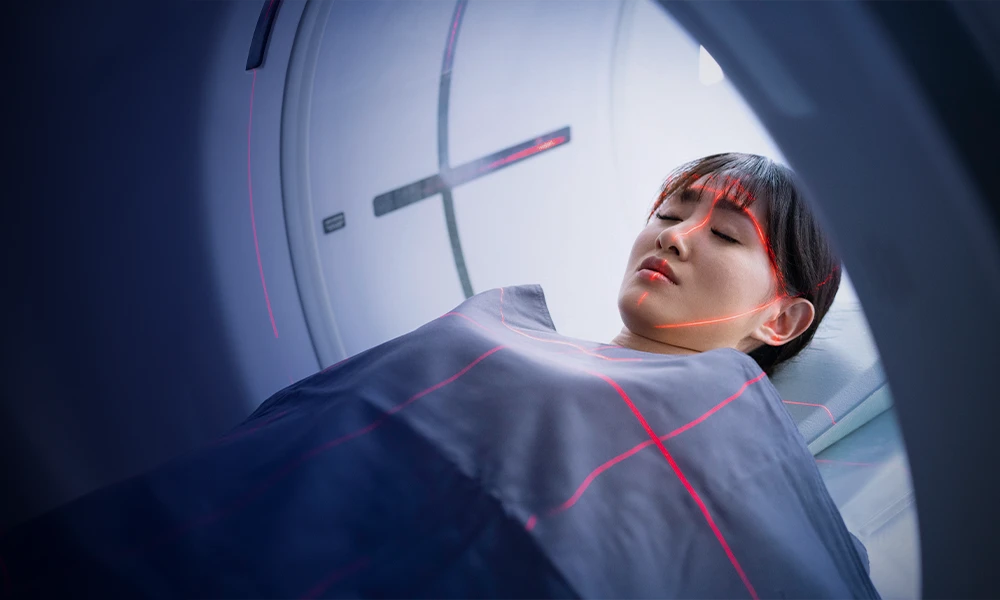
You lie down on an examining table that slides into the machine. The procedure takes about 45 minutes, and you are able to communicate with the technologist the whole time.
The read
The scan shows the distribution of the radiotracer and what is happening in many of your internal organs. Those images let the radiologist determine whether your organs are functioning appropriately.
Exam preparation
We want your exam to be as comfortable and hassle-free as possible, so we provide all the information you will need to prepare before you arrive.
Your specific exam has its own instructions. You will find them on the Exam Preparation page.
All exam preparationWhat to bring
-
Prescription or referral from your physician.
-
A list of the medications you take, including non-prescription medications and supplements.
-
Insurance cards.
-
Any previous, relevant imaging exams and reports performed outside of our network, and your medical history.
Common questions
Your radiopharmaceutical dose is prepared specifically for your appointment time; arriving on time is critical for scan viability.
Approximately 60 to 90 minutes after the tracer is injected, the time needed to allow the solution to distribute itself through your body, you lie down on an examining table that slides into the machine. The scan itself takes about 45 minutes, and you are able to communicate with the technologist throughout.
Yes. The PET half uses a radioactive solution called FDG, injected into a vein. The CT half uses X-rays to provide the anatomical detail, including the location, size and shape of anything found.
A PET/CT scan is a valuable tool in seeing changes at a cellular level and in diagnosing abnormalities. Rarely, a patient can have an allergic reaction to the chemical used in the scan, and we are equipped to handle that remote possibility immediately.
Unless your doctor told you to limit fluids, plan to drink extra fluids following your scan to help naturally flush the tracer from your system.
Find a PET/CT location near you
PET/CT is not offered at every center. Confirm the exam you need when you book.